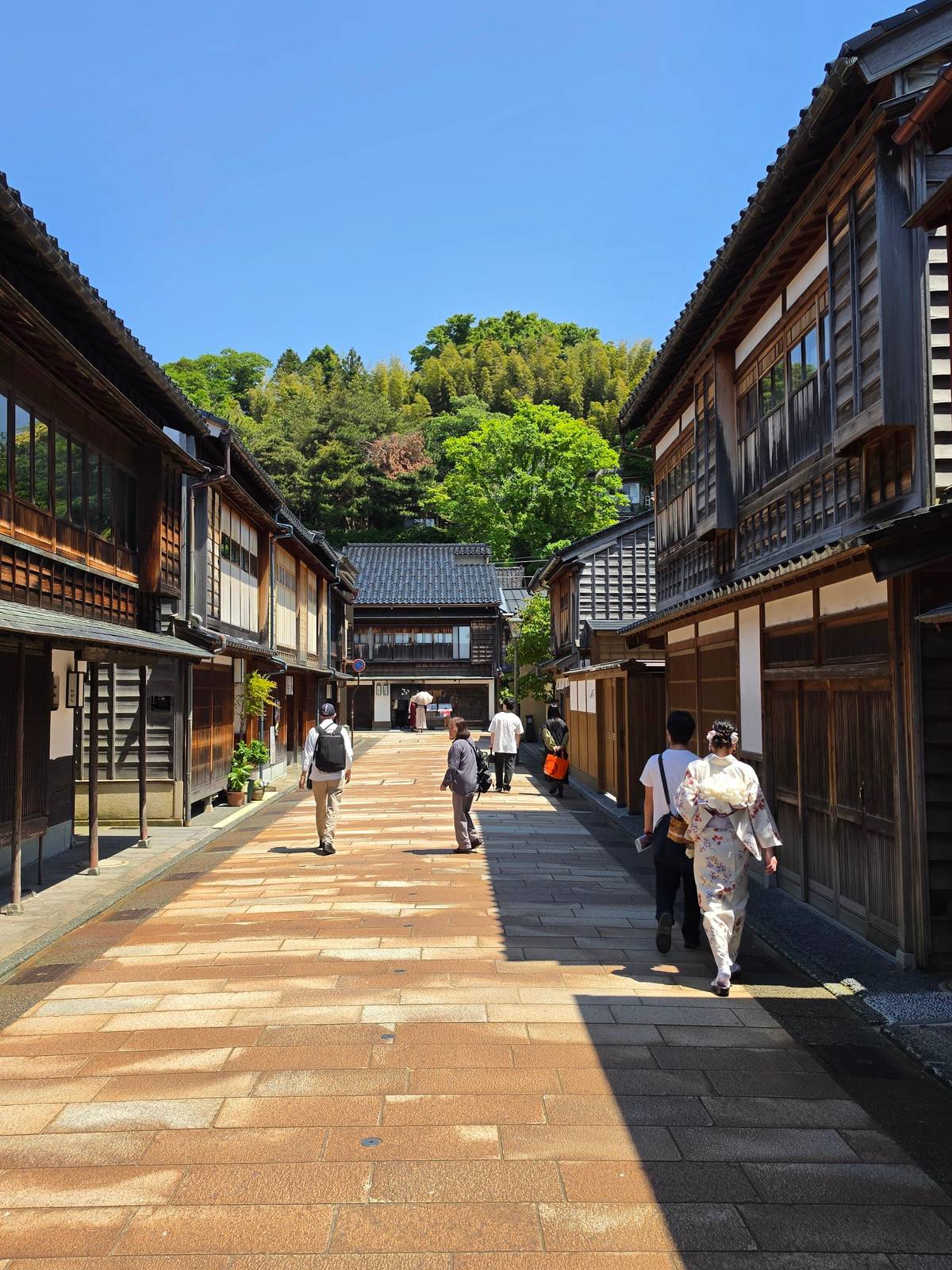
 Our walk
Castle and garden walk
Nagamachi, castle, Kenroku-en
- In the garden
- 40 minutes
- Garden ticket
- Not included
- Price
- from $61
Guides
Language
EnglishCurrency
US dollar · $GetYourGuide converts to the currency you select here.
Guide · The garden
Kenrokuen Garden from gate to gate: when it opens, what a ticket costs, how to walk in free at dawn, and which lantern, pine and tea house to find in each season.
Editorial team, kanazawacastle.comUpdated October 25, 2026Reading time 7 min80 sources
In a nutshell
Kenrokuen Garden sits right beside Kanazawa Castle, and together with Kairaku-en in Mito and Koraku-en in Okayama it is counted among the three most beautiful gardens in Japan.6 It is a strolling garden: instead of admiring it from a single veranda, you follow a loop of ponds, hills, bridges and tea houses, and the picture changes every few steps. Give it at least an hour, more if you like to sit by the water.
Its story starts in 1676, when the 5th lord, Maeda Tsunanori, built a villa called Renchi-ochin with a garden around it on the slope facing the castle.7 Later lords kept adding to it during the Edo period, so what you walk through is a layering of ideas rather than a single plan.8 After the great fires of 1759 the 11th lord, Harunaga, restored it, adding the Midori-taki waterfall and the Yugao-tei tea house in 1774.9
The name came in 1822 from Matsudaira Sadanobu, lord of the Shirakawa Domain in the north-east of Japan.10 It means a garden that combines six characteristics, which an old Chinese garden text sets out in pairs: spaciousness with seclusion, artifice with antiquity, water-courses with panoramas.511 Once you know the pairs you start to notice them, a bright lawn opening out of a shaded grove, or falling water heard from a lookout.
From villa to public park
1676
The 5th lord builds Renchi-ochin and a garden on the slope facing the castle.7
1774
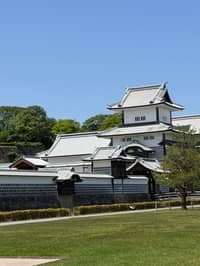
The 11th lord adds the Midori-taki waterfall and this tea house.9
1822
Matsudaira Sadanobu gives the garden the name Kenroku-en.10
1874
The garden is fully opened to the public.12
1985
It becomes a National Site of Special Scenic Beauty.13
2000
The tea house is rebuilt with the Hase-ike works.14
From 1 March to 15 October the gates open from 7:00 to 18:00; from 16 October to the end of February they open from 8:00 to 17:00.1 A ticket costs 320 yen for adults and 100 yen for children aged 6 to 17, and it is cash only, so keep coins and small notes in a pocket.23 That is the full Kenrokuen Garden entrance fee for a single visitor; groups of 30 or more pay 250 yen per adult.15
Visitors over 65 get in free by showing a passport, and wheelchairs are lent at no charge, although the paths have many slopes.1617 If the castle turrets are on your list too, the Kenrokuen+1 ticket at 500 yen covers the garden and one more cultural facility in the city.18 Smoking is prohibited throughout the park and pets stay outside.19
Early risers get a real bonus. Before the regular opening, entry is free: from 4:00 between April and August, from 5:00 in March, September and October, and from 6:00 between November and February.4 Only the Renchi-mon and Zuishinzaka entrances open at that hour, and early walkers must leave 15 minutes before the paid hours begin.20 On a summer morning that gives you the ponds, the mist and the birdsong with very few people around.
Hours by season
Three ways in
Our walkNagamachi, castle, Kenroku-en
 Most reviewed
Ticket included
Garden first, then geisha lanes
Decision helper
Match your visit to what you most want
Gates open from 4:00 to 6:00 depending on the month, at no charge.4
Its last 40 minutes are spent in Kenroku-en with a live guide.
Grouped in their traditional complementary pairs, they are spaciousness & seclusion, artifice & antiquity, water-courses & panoramas.
The official park map numbers 28 places of interest, so choose a handful rather than racing between them.28 Begin with the Kotoji stone lantern, whose legs are of unequal length, standing at the edge of Kasumiga-ike.29 Beside it the Karasaki pine reaches far over the water. Look down as well as up: the stone pavement laid in a diamond pattern shows how much thought went into even the paths.29
Hisago-ike, near the Renchi-mon gate, lies in the oldest part of the grounds: the first garden covered only the area around that gate.30 The 5th lord set three divine islands named Horai, Hojo and Eisyu in this pond, and the 13th lord, Nariyasu, later added a Horai island in Kasumiga-ike.31 The idea behind them is eternal life, a wish the Maeda rulers wrote into rock and water.32
Yugao-tei, built in 1774, is the oldest structure still standing in the garden.33 From the higher ground the view opens over the city, and on a clear day you can pick out the Uchinada dunes, the Noto peninsula, Utatsu-yama and Mt. Hakusan.34 Stop at the old pine whose roots rise out of the earth, Neagari-no-Matsu on the map, then cross the small bridges back toward the castle side.28
Map
The walk from Korinbo through Nagamachi to the castle and Kenroku-en first, then the teahouse districts and the station, then the mountain road to the thatched villages.
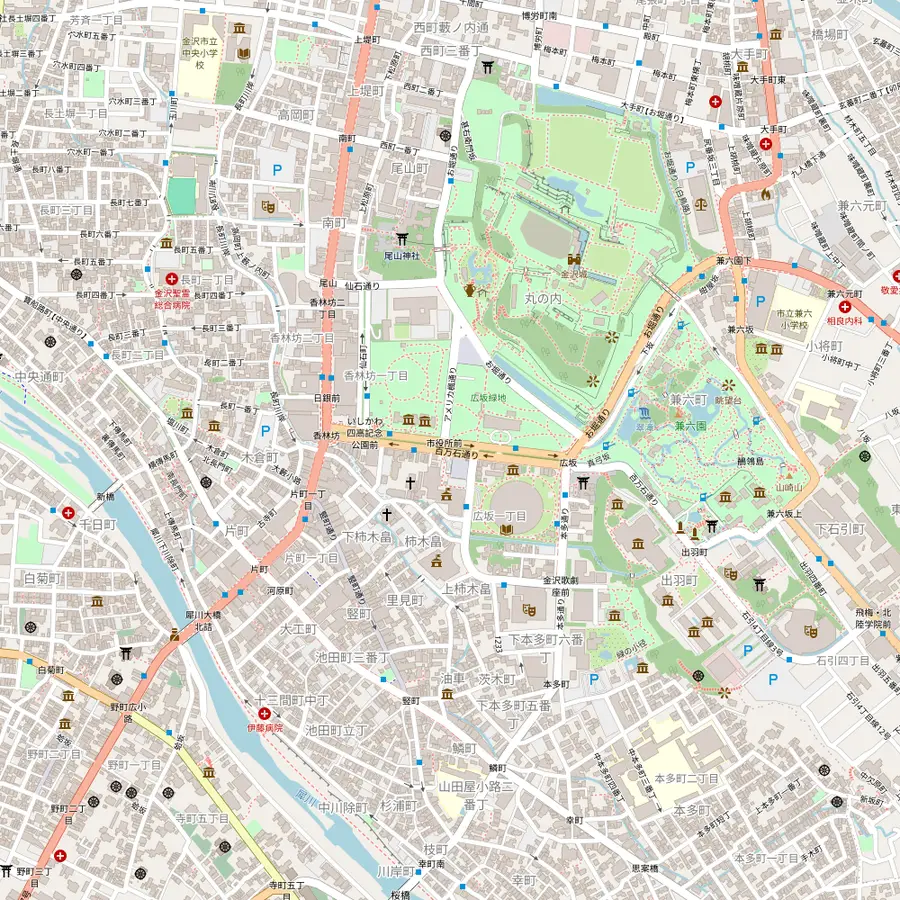 1Starbucks Korinbo (meeting point)2Nomura house, Nagamachi3Oyama Shrine4Nezumita-mon Gate5Gyokusen-inmaru Garden6Hishi-yagura Turret7Kahoku-mon Gate8Ishikawa-mon Gate9Kenroku-en10Seisonkaku Villa1121st Century Museum12D.T. Suzuki Museum
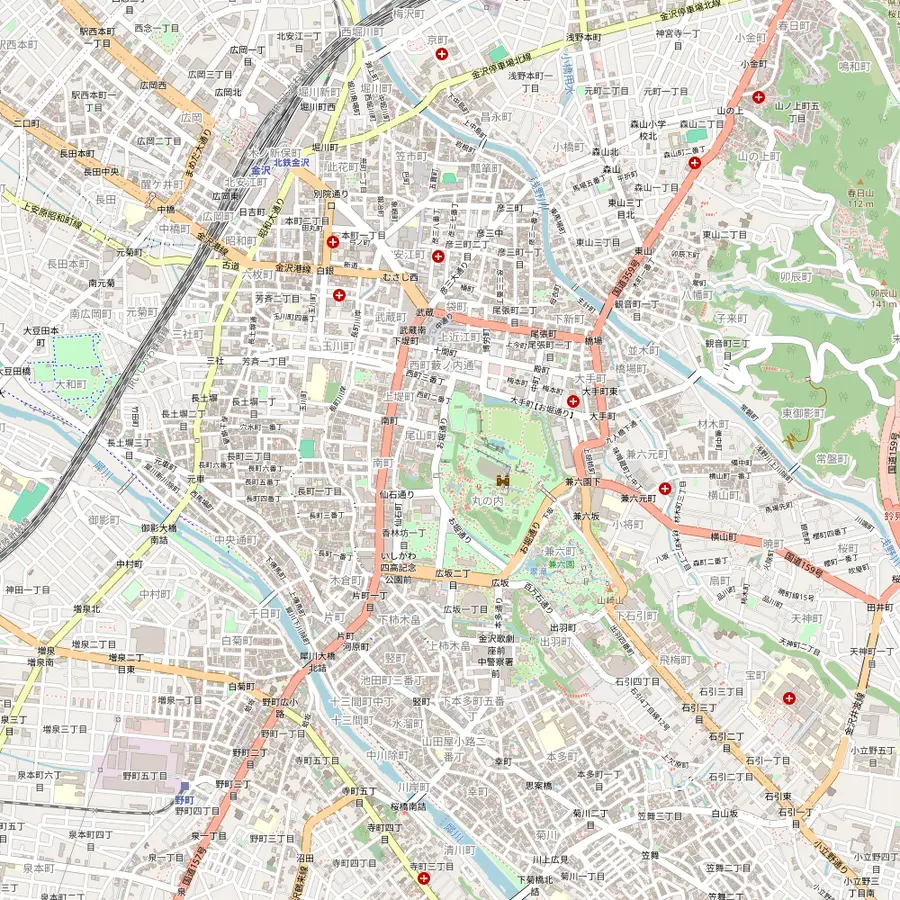 13Kanazawa Station14Higashi Chaya District15Kazuemachi16Nishi Chaya District17Myoryuji (Ninja Temple)18Kanazawa Castle (Ishikawa-mon)19Nagamachi
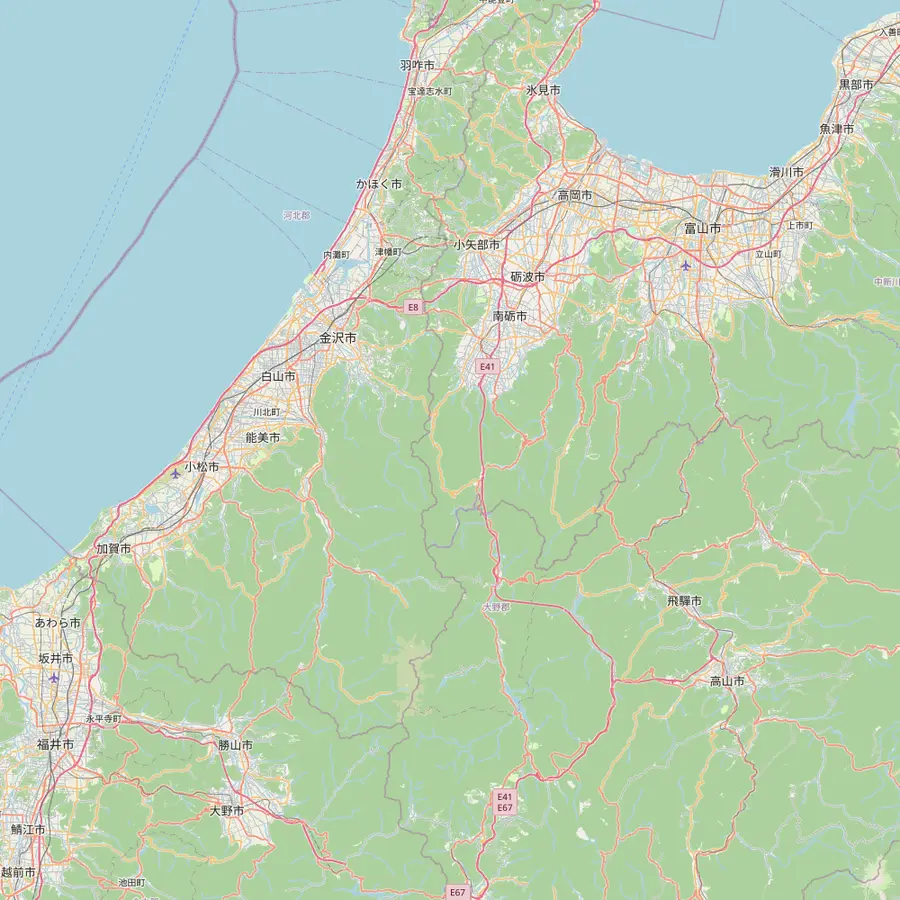 20Kanazawa21Shirakawa-go (Ogimachi)22Gokayama (Ainokura)23Takayama24Toyama25Komatsu Airport
The walking tour sold on this site meets in front of this cafe; Nagamachi is the first stop, a short walk away.
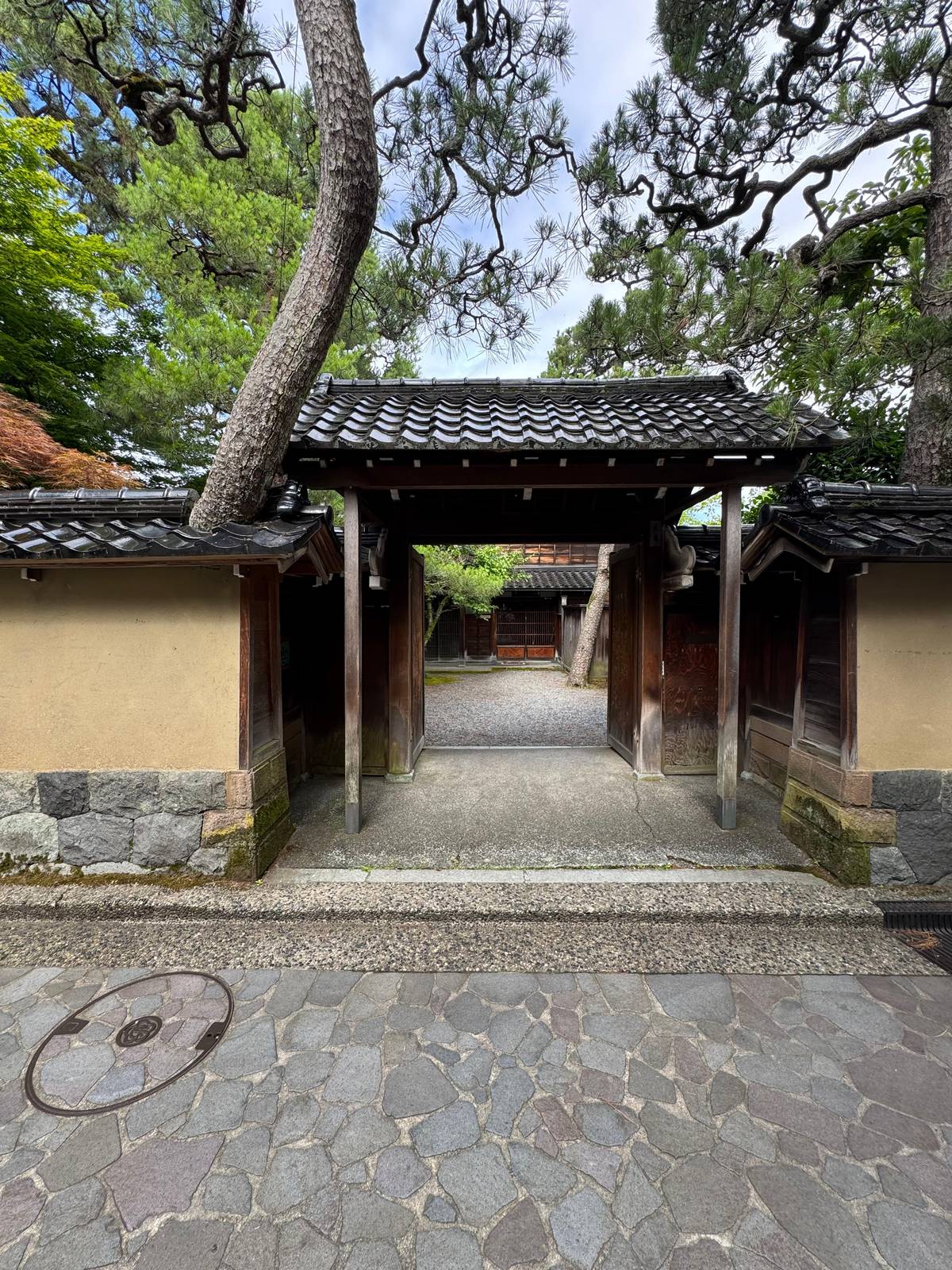
In Google Maps ↗A samurai residence with a full suit of armor on display and a garden of streams, rated two stars by the Michelin Green Guide.3536
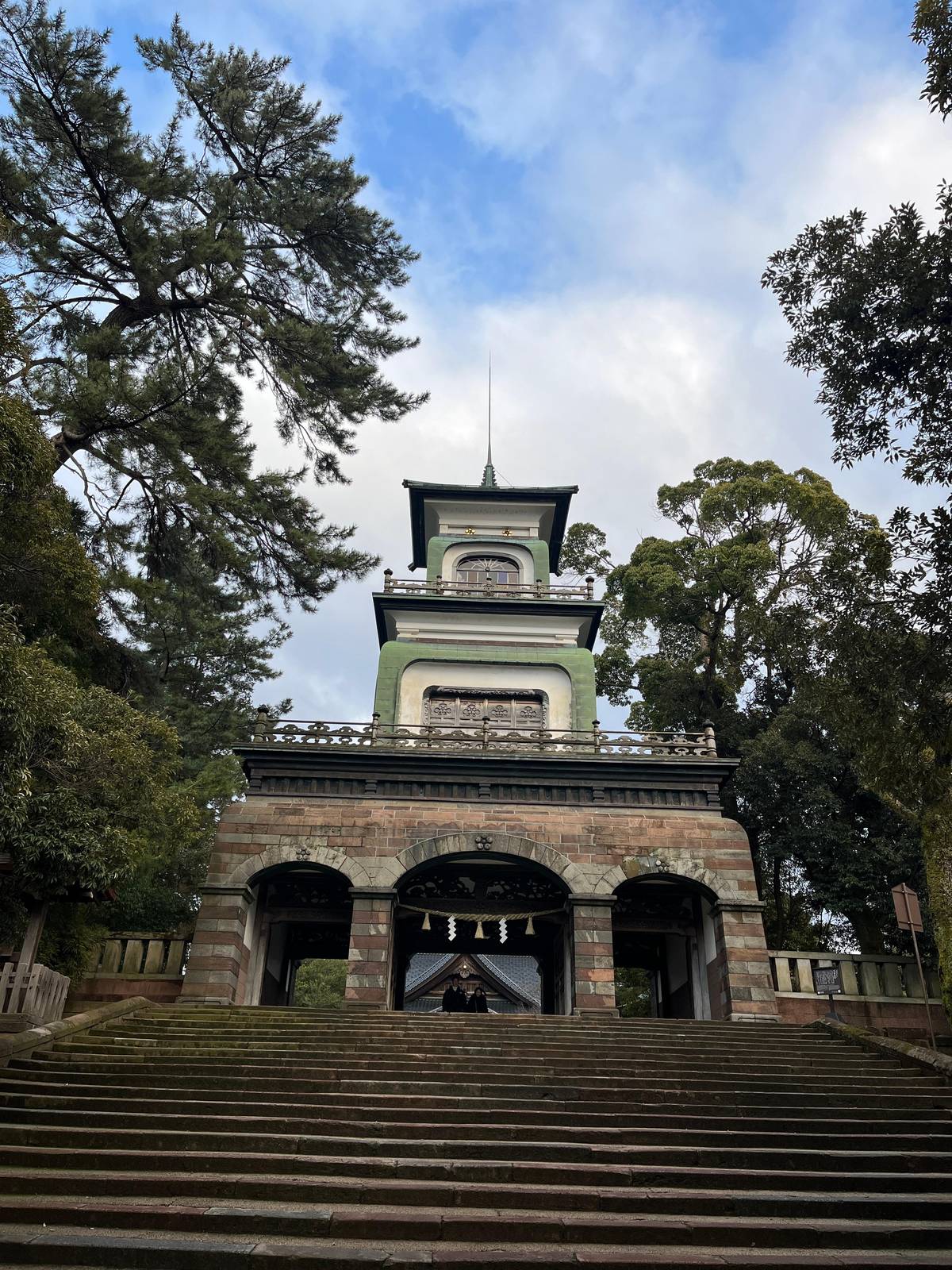
In Google Maps ↗A shrine across the moat from the western gate of the castle, reached over the restored wooden bridge.
In Google Maps ↗The one castle gate with black plaster between its wall tiles; gate and bridge were finished again in 2020.3738
In Google Maps ↗The private garden of the lords, with a 22-meter drop from its highest wall to the pond bottom, recreated in March 2015.394041
In Google Maps ↗A diamond-shaped turret built on angles of 80 and 100 degrees, open daily from 9:00 to 16:30.4243
In Google Maps ↗The working main gate of the castle, rebuilt in 2010 and free to walk through.4445
In Google Maps ↗Rebuilt in 1788, the oldest structure on the grounds, an Important Cultural Property since 1950.4647
In Google Maps ↗One of the three great gardens of Japan; adults pay 320 yen, in cash only.623
In Google Maps ↗A villa built in 1863 by the 13th lord for his mother, on the edge of Kenroku-en.48
In Google Maps ↗The free public zone and outdoor works sit beside paid exhibitions; closed on Mondays.4950
In Google Maps ↗A quiet museum with a water garden for the Zen philosopher D.T. Suzuki, entry 310 yen.5152
In Google Maps ↗The fastest Hokuriku Shinkansen, Kagayaki, reaches it from Tokyo in about 2.5 hours.53
In Google Maps ↗The largest of the three historic teahouse districts, established in 1820.54
In Google Maps ↗A small teahouse quarter on the river, protected as a preservation district since 2008.55
In Google Maps ↗Founded in 1820 as well; its little museum in a former teahouse is free.5657
In Google Maps ↗Two storeys from the street and four inside; visits only on a guided tour booked ahead.5859
In Google Maps ↗The castle park costs nothing to enter and opens at 7:00 from March to mid-October.60
In Google Maps ↗Cobblestone lanes and tiled earthen walls of the old samurai quarter.61
In Google Maps ↗Starting point for the tours and buses to the thatched villages.
In Google Maps ↗About 1.5 hours by highway bus from Kanazawa, on the UNESCO list since 1995.6263
In Google Maps ↗Registered together with Shirakawa-go as one World Heritage Site.63
In Google Maps ↗Buses link Takayama and Shirakawa-go with Kanazawa every day.64
In Google Maps ↗Shirakawa-go is also about 1.5 hours away by highway bus from here.62
In Google Maps ↗The nearest airport, about 40 minutes by bus from Kanazawa.65
In Google Maps ↗Checklist
Price calculator
Pick an option and set the number of people
Total from$121
pp from $61
Check availabilityfree cancellationEach total multiplies the lowest current GetYourGuide price of that Kanazawa listing by the number of people, converted at today’s ECB rate; the checkout page has the final amount.
Video
Nothing loads until you tap play.
In spring, cherry trees form a canopy over the path from the entrance facing Kanazawa Castle, and in Ishikawa the blossom comes out in April.2223 The prefecture names the garden one of its most popular places to see it, so the free early hour is worth setting an alarm for.23 Under the trees the light turns pink and soft, and the reflections in the ponds double the effect when the air is still.
Summer is the green season. Moss spreads like carpet through the woods below the pavilion on Yamazaki Hill, and the shade there is welcome on a hot afternoon.66 The rainy season runs from mid-June to mid-July and is very wet, so an umbrella belongs in your bag.67 The ponds look their best right after a shower, when the stones darken and the surface clears, so a wet morning is no reason to stay away.
Kenrokuen Garden in autumn rewards a slow walk: the Japanese maples and zelkovas in the south-east of the grounds turn gold, crimson and russet.24 Across the prefecture the leaves are at their brightest in mid to late November.25 That is also when the gardeners start tying the snow ropes, so a visit late in the month can give you colour and the first yukitsuri on the same morning.26
In November the groundskeepers put up yukitsuri, cones of rope fanned out from a bamboo pole, so that wet snow does not break the branches.2668 Look for the Karasaki pine wrapped in its ropes beside Kasumiga-ike, and for the smaller trees along the streams, each with its own little tent of straw rope. The lines of rope against grey sky are a sight you will not find in summer.
The first snow arrives in early December, and January and February bring most of it, though many winter days stay clear.2769 At the city's weather station the normal snowfall for January adds up to 67 cm.70 Shoes with grip matter more than a heavy coat, and the tourist information center at Kanazawa Station rents snow boots if you arrive without them.71
Winter hours are shorter, 8:00 to 17:00, so plan the garden for the morning and keep the afternoon for indoor sights such as Seisonkaku, the villa on the garden's edge, which costs 700 yen.172 Free early entry starts at 6:00 from November to February, which puts you in the garden as the first light touches the ropes.4 After a fresh fall, the stillness is the reason to come.
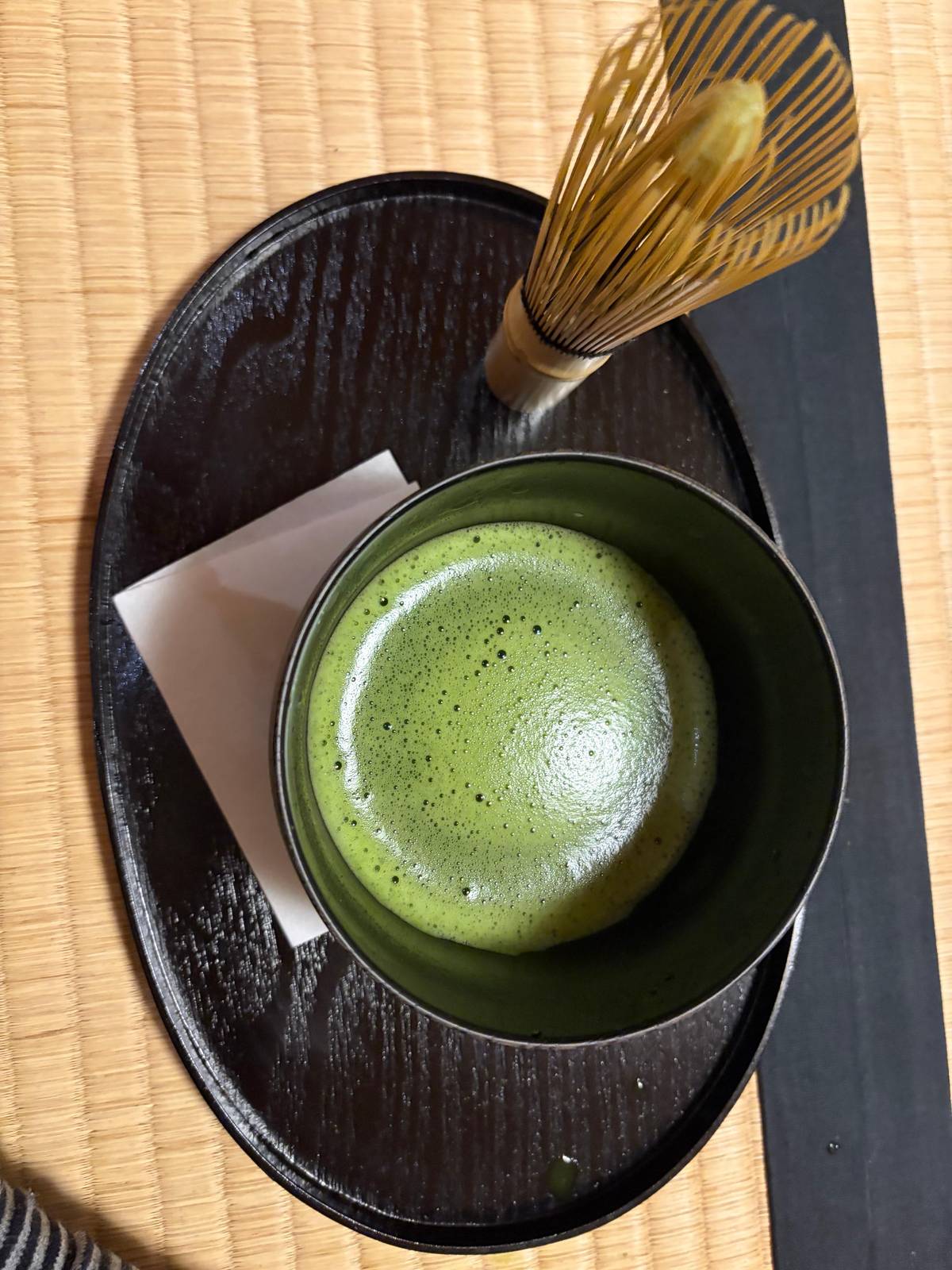
Tea houses are part of the design here, and you can still drink tea in one of them. Shigure-tei, rebuilt on its present site in March 2000, serves powdered tea with a sweet for 800 yen and green tea with a sweet for 340 yen.7321 It opens 9:00 to 16:30, with last entry at 16:00, and it closes from 29 December to 3 January.74 Sit facing the pond and take your time over the bowl.
If you want more than a cup, a guided tea ceremony in Kanazawa is the next step. One listing holds its 1-hour session inside the garden, meeting at the fountain, with an English-speaking instructor, from $35, with 1,484 reviews and a 4.81 rating. The garden ticket of 320 yen is not part of that price, so pay it at the gate first.
Inside the castle park, the Gyokusen-an rest house serves matcha with a premium wagashi sweet for 1,000 yen, looking over Gyokusen'inmaru, which is thought to have been the lords' private garden.7541 It makes a calm pause between the castle and Kenrokuen Garden, especially on a hot day, and it lets you compare the two gardens the lords kept on either side of the walls.
The walking tour on this site gives Kenroku-en 40 minutes at the end of a route through Nagamachi and the castle, with a live guide in English and an audio guide for other languages. Its listing names the Kenrokuen admission of 320 yen as not included, so carry cash for the gate. Reviews keep mentioning how the history makes the stones and ponds easier to read.
If you would rather wander on your own, volunteer guides work at the castle park and Kenrokuen every day from 9:30 to 15:30 except over the New Year holiday, mostly in English, and the guiding itself is free.76 They take no reservations: you simply turn up at the waiting area on the day.77 That suits a flexible morning; the paid walk suits anyone who wants the story in order and a fixed start.
Getting there is simple. A taxi from Kanazawa Station takes about 10 minutes, and a Kenroku-en shuttle bus runs on Saturdays, Sundays and holidays.7879 Drivers can use Kenroku Car Park, which charges 350 yen for the first hour and 150 yen for each further 30 minutes in the daytime.80 Once inside, the castle park is only a footbridge away.
Your castle walk
Pick a date, meet at Korinbo, and keep the option to cancel at no cost for up to 24 hours before.
7:00 in summer, 8:00 in winter. It opens 7:00 to 18:00 from 1 March to 15 October and 8:00 to 17:00 from 16 October to the end of February.1
320 yen for adults. Children aged 6 to 17 pay 100 yen, cash only, and visitors over 65 enter free with a passport.2316
Yes, before the gates officially open. Early entry is free, from 4:00 in summer to 6:00 in winter, through Renchi-mon and Zuishinzaka only.4
No, you pay it at the gate. The walking tour lists the 320 yen Kenrokuen admission among the things not included.
In November. Groundskeepers build the yukitsuri then, so the branches survive the weight of the coming snow.26
At least an hour. The official map lists 28 places of interest; the main ponds, lanterns and tea houses fit into a relaxed morning.28
Sources
Keep reading